Your product is growing. The pipeline is filling up. But delivery is starting to slip – not because your team is weak, but because it’s too small for the pace you’re operating at.
Have you ever think about Nearshore Development?
At this point, most enterprise organizations face two options: open a hiring process and wait 3–6 months, or find a model that lets them deliver right now. This article explains why nearshore augmentation has become the preferred answer for mature engineering organizations — and what it actually looks like in practice.
Why Hiring Doesn’t Solve the “Right Now” Problem
A standard senior engineering hire takes 3 to 6 months from job posting to first meaningful output. That includes sourcing, interviews, offers, notice periods, onboarding, and the ramp-up time before someone is genuinely productive in your codebase.
Meanwhile, your roadmap doesn’t pause. Release windows don’t shift. Backlogs grow. Senior engineers start context-switching because there aren’t enough hands, and the quality of work across the board starts to drop.
This isn’t a recruiting problem. It’s a structural capacity gap — and traditional hiring is too slow to close it when it matters most.
What Nearshore Augmentation Actually Is (and Isn’t)
Nearshore staff augmentation means external developers — typically from countries in a compatible timezone with a similar working culture — join your existing team as an integrated part of it, not as a separate contractor delivering work in isolation.
The difference from classic outsourcing is fundamental:
| Classic Outsourcing | Nearshore Augmentation | |
|---|---|---|
| Management | Separate PM on the vendor side | Developers report directly to your tech lead |
| Process | Separate backlog, separate sprints | Your Jira/Linear, your sprint cadence |
| Communication | Through an intermediary | Directly in your Slack or Teams |
| Time to first value | Weeks of knowledge transfer | Productive within 1–2 weeks |
| Risk | High vendor dependency | Full control stays with you |
At Fabres, our developers join your daily standups, work from your repositories, follow your code review process, and are held to the same standards as your internal engineers. There’s no account manager sitting between you and the person writing the code.
When Nearshore Development Makes Strategic Sense
 Not every situation calls for external support. But there are clear scenarios where it’s the right call:
1. You Have a Specific Skills Gap
Your core team is strong, but you’re missing a key competency — DevOps, QA automation, mobile (iOS/Android), ML engineering, or a specific technology stack. Hiring that specialist takes too long. Nearshore gives you that skill within a week.
2. You’re Running a Time-Boxed Project
A product rebuild, a platform migration, a major launch — these are situations where you need additional capacity for 3–9 months without creating permanent headcount. Augmentation scales with the project, then scales back down.
3. Your Internal Team Is Stuck on Maintenance
Your senior engineers are spending more time on maintenance and firefighting than building. External developers can absorb the maintenance load, freeing your internal team for product work.
4. You’ve Won a Large Client and Need to Deliver Fast
The contract is signed but the delivery timeline is tight and internal capacity won’t stretch to cover it. Augmentation closes that gap without renegotiating scope.
5. You’re Building a New Product Line Alongside Your Core Platform
You have a new product idea but don’t want to slow down the main roadmap. An external team can run the new initiative in parallel, with full visibility from your side.
Nearshore Development: What Integration Actually Looks Like

The most common concern from engineering leaders: “Will an external developer actually understand our codebase and our context?”
It’s a fair concern — and the answer depends entirely on how the onboarding is structured and what model the partner uses.
At Fabres, we use a structured ramp-up process built around three phases:
Week 1 – Technical orientation
The developer reviews the architecture, codebase, and conventions. They join standups as observers, read through existing PRs, and map the system before writing a line of code.
Week 2 – First contributions
The developer picks up clearly scoped, lower-risk tickets. They go through code review, ask the right questions, and identify any gaps in documentation or context.
Week 3 onwards – Full productivity
The developer works independently from your backlog, participates in sprint planning, and reports progress directly to your tech lead or PM.
In practice, a well-structured onboarding puts an external developer at full productivity between day 10 and day 21 — regardless of how complex the product is.
What Determines Whether Nearshore Development Works
After years of working with enterprise engineering teams, the factors that determine success in an augmentation model are consistent:
Direct communication — developers must have direct access to technical decision-makers. Every intermediary layer slows things down and distorts information.
Access to context — an external developer needs to understand why something is being built, not just what. Access to product documentation, architectural decision records, and conversations with the PM is non-negotiable.
Clear ownership — who owns each ticket on the client side? Who does the code review? Without clear answers, accountability breaks down.
Shared sprint rhythm — external developers should attend retrospectives and planning sessions. Isolating them from the sprint cadence causes drift and misalignment.
These aren’t soft suggestions. They’re the operational conditions that determine whether an augmented team delivers or doesn’t.
Scaling: From One Developer to a Full Squad
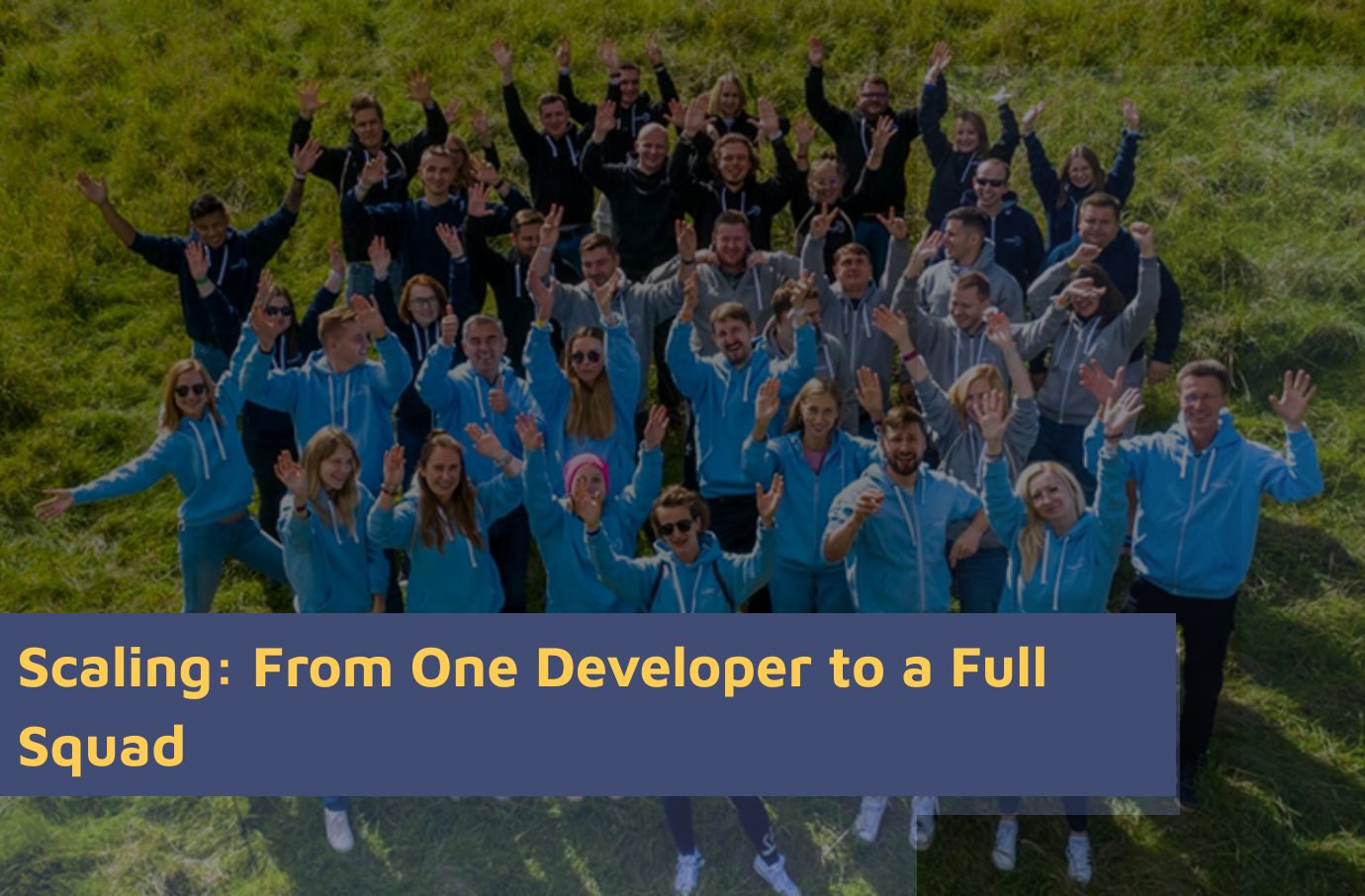
One of the key advantages of the nearshore model is the ability to scale up — and down — without rebuilding your processes.
A typical enterprise engagement at Fabres moves through three stages:
- Pilot (1–2 developers) — validate the working model, technical fit, and code quality. Duration: 4–8 weeks.
- Scale-up — based on pilot results, expand to 4–8 developers. A dedicated squad lead can be added at this stage.
- Stabilization — after the heavy build phase, some developers roll off while a smaller team handles maintenance and iteration.
No stage requires renegotiating the fundamental working model. The structure is established once and scales with the project.
The Real Cost Comparison
The nearshore conversation often starts with cost. But the right comparison isn’t “day rate vs. salary.” It’s the full picture:
- Cost of recruiting — the average cost of hiring one senior engineer (recruiter fees, internal interview time, coordination) often exceeds $10,000–$20,000 before they start
- Cost of time — 4 months without delivering a critical feature has real revenue implications or delays your market window
- Cost of failure — a misaligned freelancer or a bad hire means rework costs, not just hiring costs
- Cost of burnout — an overloaded core team starts losing senior engineers. Replacing them costs far more than a year of nearshore augmentation
Nearshore isn’t cheap — it’s fast, predictable, and scalable. That’s a different value proposition than “cheaper than a full-time hire.”
How to Evaluate a Nearshore Partner
The market is full of companies offering “augmentation.” Most of them are delivering CVs, not developers ready to contribute. A few things to look for:
Signals of a serious partner:
- They ask about your stack, architecture, and working model before proposing anyone
- They offer a short trial period (2–4 weeks) with a low-friction exit if it’s not working
- Developers communicate directly and professionally in English
- They have reference clients at a similar scale and product complexity — and you can speak to them
- They’re transparent about how they handle developer turnover and replacement
Red flags:
- CVs in your inbox within 24 hours of the first conversation (no real vetting)
- No technical interview with the candidate before signing
- Vague answers about who manages the developer on the vendor side
- Promises of “full productivity from day one”
- No clarity on what happens if the developer leaves mid-project
Closing Thought: Augmentation as a Strategic Tool, Not a Workaround
Organizations that treat nearshore augmentation as a temporary patch to a recruiting backlog get average results. Those that build it into their engineering scaling strategy — treating external developers as a genuine extension of the team — gain real competitive advantages.
Faster time to market. Higher delivery capacity. Reduced risk of burning out key engineers. Flexibility that no full-time hire can match.
If your team is operating at capacity today and hiring can’t keep up with the pace of the business, the question isn’t whether to explore augmentation. It’s how to do it in a way that actually works.
Fabres helps enterprise product teams scale delivery without scaling internal HR overhead. Our engagement model is built around full integration with your existing processes — no middlemen, no separate management layer, no black-box delivery.
Contact Bartek or Wojtek, our Strategic Partnership Managers.
→ Talk to our team | → Read our case studies |